Chapter 9: The Siege of Taif
Part I: In the Time of the Prophet (SAWS)

Page: 1
It was said, “O Messenger of Allah! Pray to Allah against the tribe of Thaqif [of Ta’if].” He said, “O Allah! Guide Thaqif, and bring them (to us).”1
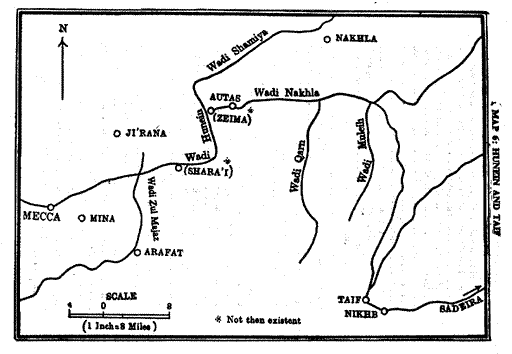
The Prophet had routed the enemy at Hunain and driven him from Autas. He now decided to give Malik bin Auf no time to recover his breath and organise further resistance. Consequently, he sent the captives and the flocks taken at Autas with an escort to Jirana, to be kept under guard until the return of the army, and the very next day he set out for Taif, where major resistance was to be encountered. But he moved cautiously, for after the unpleasant experience of the ambush at Hunain, he had no intention of letting the army walk into another trap. The country now was hilly, consisting of steep ridges rising up to the plateau on which stood Taif; and in this terrain a wily commander like Malik could lay an ambush almost anywhere.
Leaving Autas, the Prophet marched
through the Nakhla Valley and then turned south into the
Wadi-ul-Muleih. From this valley he crossed into the Wadi-ul-Qarn,
and following this wadi, reached the plateau 7 miles
north-west of Taif. So far the Muslims had encountered no
opposition and scouts had reported no sign of the Thaqeef outside
Taif; but hoping to surprise Malik, the Prophet shifted his axis.
Cutting across the difficult terrain north of Taif, he got to the
less hilly region lying east of the town, between Nikhb and
Sadaira. 2 From here he marched to Taif,
coming in from the rear. Throughout this march, Khalid again led
the army with the Bani Sulaim as advance guard. (See Map 6
below)
But Malik bin Auf, in spite of his lack of years, was not a man to be caught unawares. Having suffered grievously in his clash with the Muslims at Hunain and Autas, he was determined not to accept battle with the Muslims again in the open: he would fight them on his own terms. Consequently, he kept his army within the walled city of Taif and speedily stocked it with sufficient provisions to withstand a long siege. Here the Thaqeef, under their brave young general, awaited the arrival of the Muslims.
The Muslims got to Taif on February 5,
630 (the 15th of Shawal, 8 Hijri), and started a siege which was to
last 18 days. On arrival at Taif, the camp was set up too close to
the wall of the town and this mistake was punished by the Thaqeef
archers, who showered the camp with arrows. A few Muslims were
killed before the camp was moved away and established in the area
where the mosque of Ibn Abbas stands today. Groups of Muslims were
now deployed around the fort to prevent entry and escape; and Abu
Bakr was made responsible for the siege operations.
Most of the time, fighting between the two armies consisted of
exchanges of archery. The Muslims would close up to the town and
try to pick off the Thaqeef archers on the wall, but the Thaqeef
had the odds in their favour as they had some cover in the open. So
the Muslims got the worst of these engagements and many of them
were wounded, including Abdullah, son of Abu Bakr, who later died
of his wounds.
Thus some days passed. After the fall of Makkah, the Prophet had sent two Muslims to Jurash, in the Yemen, to learn all about siege warfare. These two men did not, however, return till after the Siege of Taif and thus could play no part in the siege. But Salman the Persian again came to the help of the Muslims as he had done in the Battle of the Ditch. As a Persian he knew something about more sophisticated forms of warfare. Under his instructions, the Muslims constructed a catapult and used it to hurl stones into the town; but the Muslims were amateurs at this business and the catapult produced no significant effect.
Salman next decided to use a testudo. (A testudo was a large shield, usually made of wood or leather, under which a group of assailants could advance to the gate of the fort, safe from enemy missiles, and either crash through the gate with a battering ram or set fire to it.) Under the instructions of Salman, the Muslims constructed a testudo of cowhide, and a group of them advanced under its protection to set fire to the wooden gate of Taif. As they got to the gate, however, Malik and his men poured red-hot scraps of iron onto the testudo. These pieces burnt the testudo and terrified those under it, so that they hurriedly dropped the unfamiliar equipment and ran back. As they ran, the Thaqeef fired a volley of arrows at them and killed one of them.
1. Mukhtasar Sirat Al-Rasul sall-Allahu
'alayhi wa sallam, of Sheikh Muhammad bin Abdul Wahhab.
2. The Wadi-ul-Muleih runs between the present
Taif Airport and Seil-ul-Kabeer. The Wadi-ul-Qarn, in its upper
reaches, crosses the present Taif-Makkah Highway 7 miles from Taif.
Sadaira is 25 miles east of Taif on the Turaba road, and Nikhb lies
just 3 miles east-south-east of Taif. The Wadi-un-Nikhb was known
in ancient times, according to local tradition, as the
Wadi-un-Naml-the Valley of Ants-through which Solomon marched
towards the Yemen for his encounter with the Queen of Sheba. The
story of Solomon is narrated in the Quran (27: 16-44).