Chapter 27: The Perilous March
Part III: The Invasion of Iraq


Page: 2
There were two known
routes available to Khalid for his march. The first was the
southern route via Daumat-ul-Jandal whence the army could move
along the normal caravan track into Syria. This was the easiest and
simplest approach, with ample water on the way and no enemy to
interfere with his movement. But it was also the longest route and
the movement would take considerable time to complete. The Caliph
had emphasised speed, as the situation of the Muslims was
apparently serious. So after due consideration Khalid rejected this
route.
The other route was the northern one along the Euphrates to
North-Eastern Syria. This too was a well-travelled route, but it
would take Khalid away from the Muslim armies, and Roman garrisons
on the Euphrates would bar his way. He could, no doubt, overcome
this opposition, but again there would be delay. He had to find
another way of getting to the Muslim forces in Syria.
Khalid called a council of war and explained the situation to his officers. "How can we find a route to Syria", he asked, "by which we avoid the front of the Romans? They will certainly try to prevent us from going to the aid of the Muslims." His reference was to Roman garrisons along the northern route.
"We know of no way", the officers replied, "that could take an army, though a single man might take such a route. Beware of leading the army astray!" 1
But Khalid was determined to find a new route, and asked his question again. None responded except one noted warrior by the name of Raafe bin Umaira. Raafe explained that there was indeed a route through the Land of Samawa. The army could proceed from Hira to Quraqir via Ain-ut-Tamr and Muzayyah, and this would be an easy march. Quraqir was a well-watered oasis in the west of Iraq. Thence to Suwa there was a little known route which led through a barren, waterless desert. At Suwa again there was ample water, and one day's journey before Suwa there was a spring which he knew would provide sufficient water for the army. The most dangerous part of the journey was from Quraqir to this spring, about 120 miles.
But Raafe cautioned: "You cannot take this route with an army. By Allah, even a lone traveller would attempt it at the peril of his life. It involves five days of extreme hardship without a. drop of water and the ever-present danger of losing the way." 2
The officers present nodded agreement. To take the army on such a route, where the entire force could get lost and die of thirst, was something that no man in his right senses would consider.
In a quiet voice Khalid said, "We shall take this route!" Seeing the look of alarm on the faces of his officers, he added, "Let not your resolve be weakened. Know that the help of Allah comes according to your deserts. Let not the Muslims fear anything so long as they have the help of Allah." 3
The effect of his words was
instantaneous. With one voice his officers replied, "You are a
man on whom Allah has bestowed His goodwill. Do as you wish."
4 And with cheerful enthusiasm the army of
Khalid set about its preparations for the march to Syria on a route
that no army had travelled before and which was known only to one
man, Raafe bin Umaira. (See Map 15 below.)
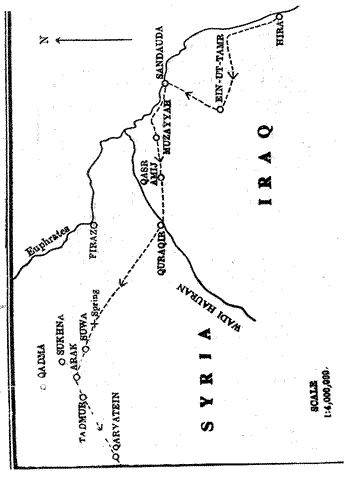
In early June 634 (beginning of Rabi-ul-Akhir, 13 Hijri) Khalid marched from Hira with an army of 9,000 men. 5 No women and children accompanied the army; they were left behind under Khalid's orders for despatch to Madinah, where they would remain until it was convenient to have them moved to Syria. The army moved via Ain-ut-Tamr, Sandauda 6 and Muzayyah to Quraqir; and Muthanna accompanied Khalid up to here before returning to Hira to resume watch over the new frontier with Persia. For the night the army camped at Quraqir and filled its water skins and other containers with supplies of water that were expected to last the men and animals five days.
1. Tabari: Vol. 2, p. 603.
2. Ibid: Vol. 2, p. 609.
3. Ibid: Vol. 2, p. 603.
4. Ibid: Vol. 2, p. 609.
5. The strength of the force that took part
in this march has been given variously as 500, 700, 800, 6.000 and
9,000; but the last figure is the correct one. It was the strength
of half the army as ordered by Abu Bakr; and all the early writers
in their accounts of the campaign in Syria, have said that the
Muslim forces included 9,000 men who marched with Khalid from
Iraq.
6. Sandauda is the ruined Mashaihad which
lies a few miles east of the present Ramadi. (Musil, p.
299)