Chapter 27: The Perilous March
Part III: The Invasion of Iraq


Page: 6
Tribal contingents responded eagerly to the call from Madinah. They came in thousands from all over the peninsula. From as far away as Oman and the Yemen. They came mounted and armed for battle, but also brought their women and children with them. Only those who had apostatised were excluded from the summons. The concentration of the able-bodied manhood of Muslim Arabia was both begun and completed in March 634 (Muharram, 13 Hijri).
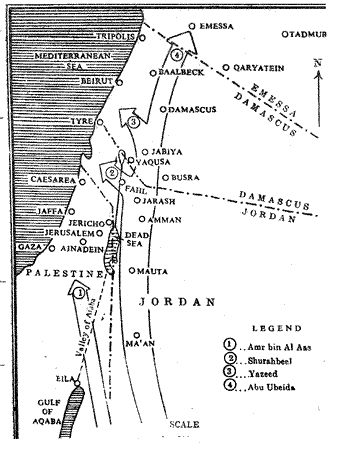
Abu Bakr now organised the available manpower into four corps, each of about 7,000 men. The commanders of these corps and the objectives given to them were as follows:
a. Amr bin AI Aas:
Objective Palestine. Move on Eila route, then across Valley of
Araba.
b. Yazeed bin Abi Sufyan: Objective Damascus. Move on
Tabuk route.
c. Shurahbil bin Hasanah: Objective Jordan. Move on
Tabuk route after Yazeed. (Shurahbil had fought in the Iraq
Campaign under Khalid, and had recently been sent as a messenger to
Madinah, where the Caliph detained him and gave him the command of
a corps for the Syrian Campaign).
d. Abu Ubaidah bin Al Jarrah: Objective Emessa. Move
on Tabuk route after Shurahbil.
Abu Bakr's intention was to invade Syria
and take as much of it as possible. (See Map 16 below.) Not being
aware of the size and detailed dispositions of the Roman army, he
did not strengthen any one corps at the expense of the others. But
he realised that the Romans could concentrate a very large army in
any sector of the theatre of operations, and consequently ordered
that the corps commanders would, keep in touch with each other and
that any one of them could seek the help of his comrades if a
serious clash with Roman forces appeared imminent on his front. In
case the corps had to concentrate for one major battle, the command
of the entire Muslim army would be taken by Abu Ubaidah.
In the first week of April 634 (beginning of Safar, 13 Hijri), the Muslim forces began to move. The first to leave Madinah was Yazeed; and as his column started from its camp outside Madinah, Abu Bakr walked for a short distance by his side. His parting words to Yazeed, which he repeated to the other corps commanders, were as follows:
In your march be not hard on yourself or your army. Be not harsh with your men or your officers, whom you should consult in all matters.
Be just and abjure evil and tyranny,
for no nation which is unjust prospers or achieves victory over its
enemies.
When you meet the enemy turn not your back on him; for whoever
turns his back, except to manoeuvre for battle or to regroup, earns
the wrath of Allah. His abode shall be hell, and what a terrible
place it is!
And when you have won a victory over your. enemies, kill not women or children or the aged and. slaughter not beasts except for eating. And break not. the pacts which you make.
You will come upon a people who live like hermits in monasteries, believing that they have given up all for Allah. Let them be and destroy not their monasteries. And you will meet other people who are partisans of Satan and worshippers of the Cross, who shave the centre of their heads so that you can see the scalp. Assail them with your swords until they submit to Islam or pay the Jizya.
I entrust you to the care of Allah 1
In making this speech Abu Bakr was following the example of the Holy Prophet, who, when despatching a military expedition, would instruct its commander: "Fight in the name of` Allah: fight but do not exceed the bounds; and do not be treacherous; and do not mutilate; and do not kill women and children; and do not kill the inmates of monasteries." 2 It is reported that Abu Bakr walked beside Yazeed for nearly 2 miles, and when Yazeed asked him to return, said, "I heard the Messenger of Allah say that the feet that get covered with dust in the way of Allah shall not be touched by the fire of hell." 3