Chapter 34: The Eve of Yarmuk
Part III: The Invasion of Iraq


Page: 2
Heraclius decided to organize a massive and overwhelming retaliation. He would raise such an army as had never been seen in Syria, and with this army he would bring the Muslims to battle in such a way that few, if any, would escape his clutches. This was to turn defeat into a glorious triumph.
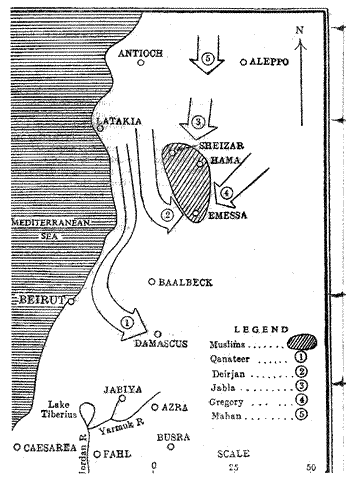
In late 635, while Emessa was under siege, Heraclius began preparations for this great manoeuvre. Entire corps were gathered from all parts of the Empire and these were joined by princes and nobles of the realm and dignitaries of the church. By May 636, an army of a 150,000 men had been put under arms and concentrated in the area of Antioch and in parts of Northern Syria. This powerful military force consisted of contingents of Russians, Slavs, Franks, Romans, Greeks, Georgians, Armenians and Christian Arabs. 1 No people of the Cross living in the Byzantine Empire failed to send warriors to the new army to fight the invaders in the spirit of a Christian crusade. This force was organised into five armies, each of about 30,000 soldiers. The commanders of these armies were: Mahan, King of Armenia; Qanateer, a Russian prince; Gregory; Dairjan; and Jabla bin AI Eiham, King of the Ghassan Arabs. Mahan2 commanded a purely Armenian army; Jabla had an exclusively Christian Arab force under him; and Qanateer commanded all the Russians and Slavs. The remaining contingents (all European) were placed under Gregory and Dairjan. 3 Mahan was appointed Commander-in-Chief of the entire imperial army.
At this time the Muslims were split in four groups: Amr bin Al Aas in Palestine, Shurahbil in Jordan, Yazeed at Caesarea, and Abu Ubaidah and Khalid at Emessa and to the north. In this dispersed situation the Muslims were so vulnerable that each of their corps could be attacked in turn without the least chance of fighting a successful battle. And this situation was fully exploited by Heraclius in the plan which he put into execution.
Caesarea was reinforced by sea and built up to a strength of 40,000 men. This force was to tie down Yazeed and his besieging corps so that he would be unable to move to join his comrades. The rest of the imperial army would operate on the following plan:
a. Qanateer would move along the
coastal route up to Beirut, then approach Damascus from the west
and cut off Abu Ubaidah.
b. Jabla would march from Aleppo on the direct route to
Emessa via Hama, and hold the Muslims frontally in the Emessa
region. The Christian Arabs would be the first to contact the
Muslim Arabs, and this was probably in the fitness of things. As
Heraclius said to Jabla: "Everything is destroyed by its own
kind, and nothing cuts steel but steel." 4
c. Dairjan would move between the coast and the Aleppo road
and approach Emessa from the west, thus striking the Muslims in
their flank while they were held frontally by Jabla.
d. Gregory would advance on Emessa from the north-east and
attack the Muslims in their right flanks at the same time as they
were struck by Dairjan. 5
e. The army of Mahan would advance behind the Christian
Arabs and act as a reserve.
Thus the Muslim army would be swallowed
up at Emessa by a force perhaps 10 times its size, attacking from
all directions, with its escape routes severed. (See Map 19 below)
This would be more than even Khalid could handle! After the
annihilation of the Muslims at Emessa, the imperial army would
advance south while the garrison of Caesarea would advance from the
coast and in several battles the Roman armies would attack and
destroy each Muslim corps in turn, concentrating against each corps
in overwhelming strength.
Special services were held all over the Empire for the victory of the imperial army. Generals and bishops exhorted the men to fight in defence of their faith and save their land and its people from the alien invaders. And on this masterly design the imperial army was launched from Antioch and Northern Syria some time in the middle of June 636.
1. Waqidi: p. 100.
2. This monarch's name has also been given
as Bahan.
3. Waqidi: p. 106.
4. Ibid.
5. Waqidi (p. 107) gives the route of
Gregory as "from Iraq". Since most of Western Iraq was now in
Muslim hands, this could only mean such an approach as I have
suggested.