Chapter 36: The Completion of the Conquest
Part III: The Invasion of Iraq


Page: 5
Following the surrender of Antioch, Muslim columns moved south along the Mediterranean coast and captured Latakia, Jabla and Tartus, thus clearing most of North-Western Syria of the enemy. Abu Ubaidah next returned to Aleppo, and during this move his columns subdued what remained of Northern Syria. Khalid took his Mobile Guard on a raid eastwards up to the Euphrates in the vicinity of Munbij, but found little opposition. In early January, 638, he rejoined Abu Ubaidah at Aleppo.
All of Syria was now in Muslim hands. Abu Ubaidah left Khalid as commander and administrator at Qinassareen, and returned with the rest of his army to Emessa, where he assumed his duties as governor of the province of Emessa, of which Qinassareen was then part. From Qinassareen Khalid would keep watch over the northern marches.
By the end of 16 Hijri (corresponding roughly to 637 A.D.) all Syria and Palestine was in Muslim hands, except for Caesarea which continued to hold out. The various Muslim commanders settled down to their duties as governors of provinces: Amr bin Al Aas in Palestine, Sharhabeel in Jordan, Yazeed in Damascus (but currently engaged at Caesarea) and Abu Ubaidah in Emessa. Khalid had a lower appointment as administrator in Qinassareen under Abu Ubaidah. This state of peace continued for a few months until the mid-summer of 638, when clouds again darkened the sky over Northern Syria. This time the Christian Arabs of the Jazeera took to the warpath.
Heraclius was no longer able to attempt a military comeback in Syria. In fact he was now more worried about the rest of his Empire, which, after the destruction of his army at Yarmuk and Antioch, was extremely vulnerable to Muslim invasion. He had few military resources left with which to defend his domains against an army which marched from victory to victory. To gain time for the preparation of his defences it was essential to keep the Muslims occupied in Syria, and he did this by inciting the Arabs of the Jazeera to take the offensive against the Muslims. Bound to him by ties of religion, they submitted to his exhortations; and gathering in tens of thousands, began preparations to cross the Euphrates and invade Northern Syria from the east.
Agents brought Abu Ubaidah information on the preparations being made in the Jazeera. As the hostile Arabs began their move, Abu Ubaidah called a council of war to discuss the situation. Khalid was all for moving out of the cities as one army and fighting the Christian Arabs in the open, but the other generals favoured a defensive battle at Emessa. Abu Ubaidah sided with the majority, and pulled in the Mobile Guard from Qinassareen and other detachments from places which they had occupied in Northern Syria. He concentrated his army as Emessa and at the same time informed Umar of the situation.
Umar had no doubt that Abu Ubaidah and
Khalid would hold their own against the irregular army which now
threatened them; but he nevertheless decided to assist them, and
did so in a most unusual manner. He sent instructions to Sad bin
Abi Waqqas, the Muslim Commander-in-Chief in Iraq, to despatch
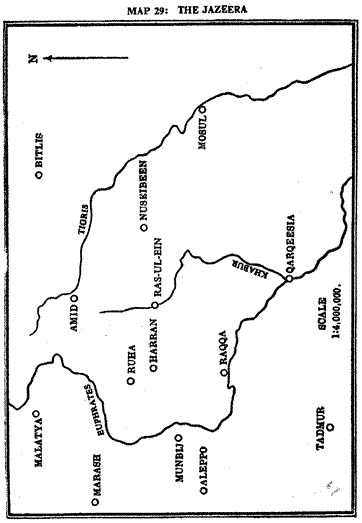
three columns into the Jazeera: one under Suheil bin Adi directed
at Raqqa, another under Abdullah bin Utban directed at Nuseibeen
and a third under Ayadh bin Ghanam operating between the first two.
(See Map 29 below) At the same time Umar ordered the despatch of
4,000 men under Qaqa bin Amr from Iraq to Emessa, along the
Euphrates route, to reinforce Abu Ubaidah.